Paid Advertisement
“I Shall Publish Their Names”
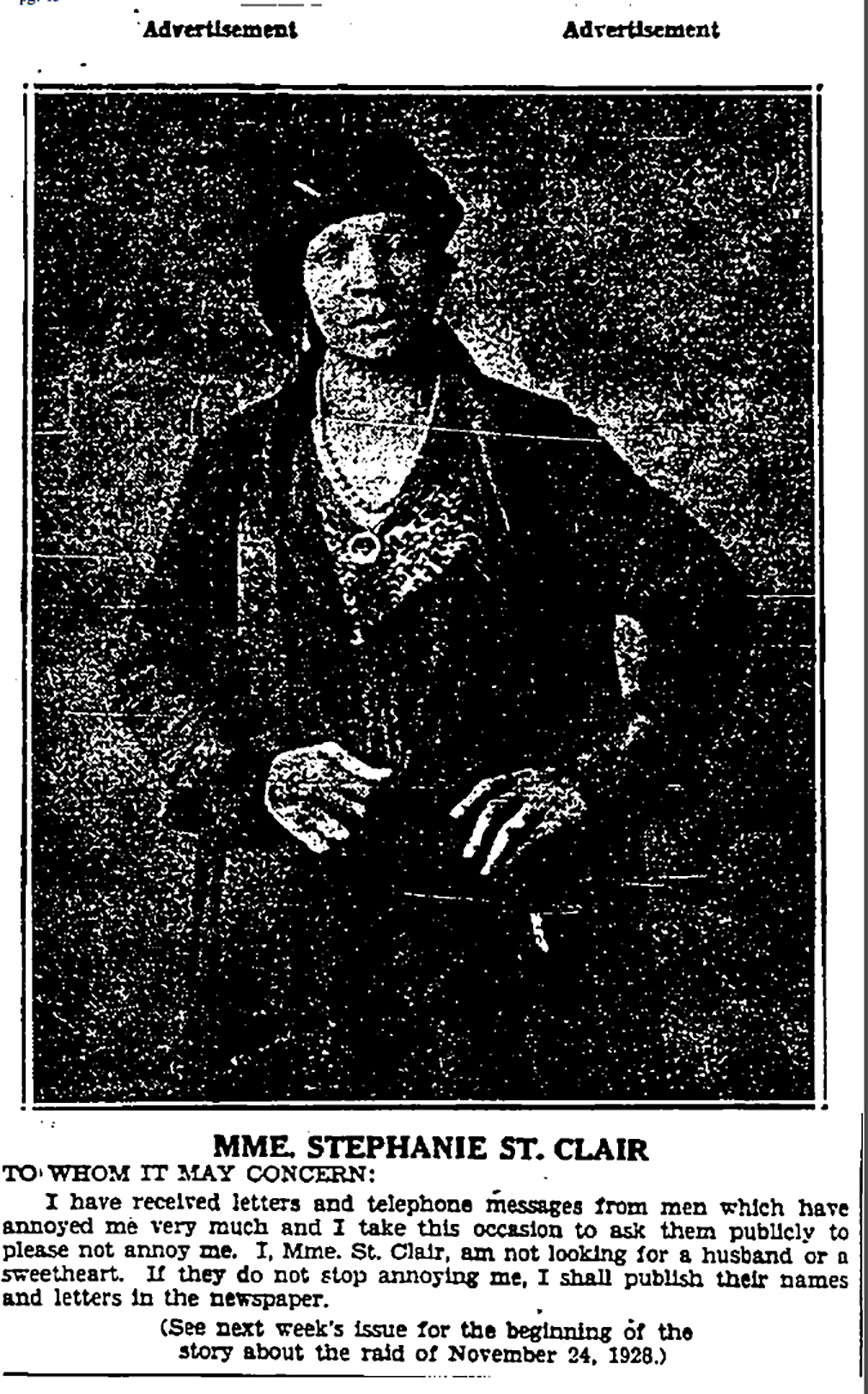
A numbers banker buys a full portrait and a warning to her suitors, then promises the paper’s readers a serial.
TRUE STORY Read off the page, 31 October 2026.
“The only reason we know as much as we do about St. Clair,” Smithsonian wrote in 2021, “is because she made a point of telling us.” She paid the Amsterdam News to run her portrait and her words. Matthew Delmont found that she ran ads there “frequently, informing readers about legal rights, police brutality, and other issues.”
The Raid of November 24, 1928
She promised the story would begin the next week. These are the issues to find.
What the other papers confirm: she said the police “framed” her and sent her to the workhouse, and by December 1931 a Seattle weekly reported she had “served a term on Welfare Island for the possession of number slips.” In December 1930 she carried her complaint to the inquiry into the lower courts, saying she had paid magistrates and police for protection she never got.
Works published in 1929 and 1930 are now in the U.S. public domain, so those Amsterdam News pages can be shown in full once found.
Her Words, as the Papers Printed Them
Quoted in the press of her own time, read off the Library of Congress scans.
“her head is not worth a nickel here”As reported when she fled New York. The Northwest Enterprise (Seattle), 23 April 1931. TRUE STORY
“As ye sow so shall ye reap”Her telegram to the dying Dutch Schultz, signed “Madame Queen of Policy,” as told in George Ross’s column, The Washington Daily News, 21 June 1938. SOURCES DISAGREE Smithsonian (2021) gives “so shall you reap.”
“framed her and had her sent to the work house”Her claim, as the Norfolk Journal and Guide put it, quoted in the Richmond Planet, 27 December 1930. TRUE STORY
“The policy game is my game.”On Schultz, quoted in Smithsonian (Durn, 2021). Original source not named. TO CHECK
Scratch the slip for her whole story. Or play the number in the weeks she testified.
The Press on Her, 1930–1938
Twelve clippings from the Library of Congress. Tap one to read it. The papers’ racial terms for her are left as printed.
She spoke for herself
She bought the space, wrote the copy and promised her readers a serial. When a paper printed a story she disputed, she sued it for $25,000. When she said police took her money, she went to court for it, and was still pressing the claim in 1932.
The Black press answered
Not everyone cheered. In December 1930 the Richmond Planet, a Black paper, reprinted the news of her testimony and then argued against the game itself: “no one should make such people feel that they are gloriously privileged to sin, gamble and squander their earnings.” A 1932 item put it plainly: in most cities, “the very poor are the best patrons.”